
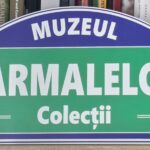


AI was invited to the opening of the exhibition OALA DE SARMALE A BUNICII. A traveling exhibition, collaboration between the Satu Mare County Museum, the National Museum of the "Dimitrie Gusti" Village in Bucharest, the Astra Museum in Sibiu, the Bănățean Village Museum in Timișoara and the County Museum of History and Art in Zalău.


During the exhibition, sarmal pots of different sizes from the collections of the five museums were exhibited, some with a capacity of 1,500 sarmals, such as those from the Banat area, but also of considerable age, over 150 years. Current replicas of pots and ceramic vessels, made by Csibi Csaba, from Borla, were also on display, and he also gave a pottery demonstration. Csibi Csaba is a very skilled potter who continues the tradition by executing special pieces, representative of pottery from Sălaj county.


"It doesn't seem accidental to me to choose this type of heritage piece, the sarmale pot. Regarding traditional food, we are used to saying: sarmaua, traditional Romanian product (...) It is a real battle to identify those recipes due exclusively to the Romanian space. However, the opinions are divided, but it is important to bring this theme into the exhibition, because no matter who we attribute the authorship of this type of food, what the traditional Romanian space, the peasant kitchen shows us, I would rather do this framing, shows us the extraordinary adaptability of this foods. Beyond the fact that the regional and local names are very diverse, the method of preparation, the ingredients used are so diverse, which confirms the adaptability to household resources, at everyday or festive time, when this kind of food is prepared, which justifies the importance of this theme", said at the opening of the exhibition, Corina Bejinariu, manager of the Museum of History and Art in Zalău.
"It is therefore 'Grandma's sarmale pot', a grandmother who, here, made sarmale in several areas of the country, as can be seen from the pieces exhibited here, because we have a collaboration between five museums in the country(...). Each museum put, as in a kind of game, seven of the most representative pieces, so the result was, practically, a collaboration that materialized in the way of more beautiful and the most representative pieces that each museum has", a stated Camelia Burghele, ethnologist at the Zalău Museum.

A round table was also organized with the theme "Fasting and sweets in the traditional village", with reference, in particular, to sarmales. In fact we talked more about...pyroshes. Grațiana Pop, folk craftsman from Ciumărna, but also a special housewife, told us that pirostes were not missing from the table on Sundays, as they were also on holidays, they were the basic food. Fast or sweet, it depends on the season.
"Here, the dish is found in a great diversity, especially in rural communities, where the Romanian peasant has adapted to the resources of the household to cook. Boace, dumplings, piroshte... Because it is a filling food and not very expensive, sarmales have become one of the basic dishes of the peasant household, being better individualized compared to other recipes of other peoples", said the ethnologist Camelia Burghele. "Even the names by which they were known stood out for their diversity."
I talked more about the pirostes in our area. In my attempts to promote local popular food, I am particularly concerned with identifying the gastronomic peculiarities of the villages of Sălaj. I said that the dish was more commonly known as boac, boti, cutcuşi, stuffed belt, dumplings, gnocchi, piroste, doll, punch, tamboc or tioast, less as sarmale.
As for the variety of sarmals, it is large, given by the ingredients and the technique used by each housewife to prepare this dish. The differences in taste are incredibly large, not only from street to street, but also from house to house. Some insist on dill or thyme, others add a lot of pepper because they like it hotter. Also, the sauce in which they are cooked differs a lot. Some put moare (sauerkraut juice) mixed with water, others put bone soup, others plain water or water with "family juice" (tomato juice), others make a sauce of fried onions, peppers and tomatoes. There are others who boil them in wine - I ate at Mircea Dinescu's, in the Cetate, delicious goose fillets boiled in wine, he has a wine cellar. Then the filling varies. I have seen pirošte with different meats and different combinations, in addition to meat, and here I mean arpacaş, pasat, razalai, patura (small grasshoppers, "fried" before in the pan), with beans, with potatoes (to the Slovaks from the village of Sălăje Făgetu) and hribi, the recipes are adapted to household ingredients. As for the meat used by rural women, most opt for fatty pork, but they are also made with a mixture of pork and beef, or the fattier part of the turkey breast, towards the goiter, turkey meat, less often game (deer , wild boar), fresh minced meat mixed with smoked ham, mushrooms, pasture and many vegetables. A very common variant in the Romanian village of the past was the one in which the animal ingredient was represented only by "a jumăra", i.e. a one-centimeter cube of bacon or fatter ham placed in each piroška in the basic composition, onion, pâsat or razalai , sometimes carrot or dried mushrooms. 80 years ago, that was pretty much all the meat in the piroshte; he also put a smoked bone in the pot, while boiling, without meat on it, just to give it a taste and that was all. In some houses, even on holidays, they cooked like this. The peasant rarely ate meat, because the pig slaughtered at Christmas had to reach them until the following Christmas. A pig from Christmas to Christmas, even if the families were large, seven, eight people, often more than ten members!
Of course, the round table "Fasting and sweet in the traditional village" ended with a tasting of piroste and tioashte. Fast and sweet...
PHOTO Credit: Nicu Gozman, Mircea Groza, Sebastian Olaru (Agerpres)


 English
  Romanian