


About 15,000 Slovaks live in Romania. The largest communities are in Bihor and Arad counties.
In Sălaj county there are several communities (Huta-Bogdana, Buciumi commune, Marca-Huta in Marca commune, Dealu Corbului, Sâg commune, there are also some hamlets, some with wonderful names, such as Culcuș or Fufez), most of them being assimilated with except for the one in Făgetu, where approximately 750 people still live (200 houses) and the one in Dealu Corbului (50-60 inhabitants, 14-15 inhabited houses and others abandoned). Many of the Slovaks from Făgetu, but also from the other mentioned localities, are temporarily away to work in Slovakia or Austria.
Au venit aici în urmă cu aproximativ două secole ca tăietori de lemne fiind împroprietăriți ulterior cu terenurile defrișate. Astăzi preocuparea principală a slovacilor de la Făgetu este agricultura și creșterea animalelor. Iernile grele și slaba fertilitate a solului i-a făcut să cultive mai mult cartofi și secară. De altfel cartoful este alimentul de bază. În fiecare gospodărie găsești gropi adânc săpate unde cartofii sunt depozitați până primăvara.


Slovaks from Făgetu use potatoes in many dishes, it is the basic food as I said. They prepare a more special potato pie, polisneac, in two versions. In the pan, polesnak, or in the tray in the oven, tocne, pronounced tocine. These pies are made from grated, squeezed, seasoned potatoes, with the addition of flour and sometimes eggs and even cheese. It is somehow similar to rösti. Also with potatoes they make a kind of dumplings, halusky, with cheese, brynzove halusky, or with cabbage and pieces of smoked bacon, kapustove halusky so slaninou. The potato is used in all soups, in smoked ones, with beans, even in green salad soup. Also here I found a recipe for green bean soup... dry, with cream and potatoes. This green bean is a certain variety, the princely bean is called. It is cultivated specifically to be dried like this with sheaths and everything. In the winter it is hydrated and soup is made, with potatoes of course (sometimes also with mushrooms which are found in abundance here. The mushrooms are dried for the winter and are used in many dishes).
I have also met this soup, but without potatoes, in the Romanian villages of Sălaj county. It is also made sweet, with smoke and coarse (that is... buffalo cream), but also for fasting with broth (homemade tomato juice, thick and aromatic). In Cizer, this soup is called zama de pasula-n gaci. In the village of Marin it is called zama de pasula with hospe.
Returning to Făgetu, where I did research quite often, I noticed that the Slovaks have adapted very well here, they have a compact community, only one family of Romanians lives in the village, the others being all Slovaks. They took over many recipes from the Romanians from the villages in the valley or from the Hungarians from the Nușfalău area, Șimleu Silvaniei or from the villages from Bihor.
I spoke here with Ioan Pisek who is 86 years old and who told me that he runs the household together with his son Iancu and gets through the hard winters only thanks to the potato reserves in his pit, over two tons every year.

Because we are talking about piroște, tyoaște (I put a "y" to make you try a pronunciation as close as possible to the original) or filled cureti as the little girls from the villages in the valley, Plopiș, Iaz or Cosniciu call them, we will also talk about the pirostes that are made in Făgetu. As I said, here the pirosti necessarily have potato in their composition, regardless of whether they are made with pork, veal or smoked meat, or if they are made only with mushrooms, mushrooms in particular. They are always wrapped in sauerkraut. So the Slovak sarmales with potatoes are called zakrucana kapusta so zemiakmi, or in Romanian, cabbage and potato twirling. I told you that among the names of sarmals in the area is this one, spun...
Further down, in the valley, in Plopiș, Iaz, or a little further in Cosniciu, the piroste are tyoaște and are also made with sauerkraut, in the winter, or sweet cabbage, in the summer. They are made with rice or razalai (homemade pasta). Lenten ones are made with horseradish and mushrooms, lots of onion and sometimes carrot. In the summer, vine leaves, stevia, loboda, or turnip (beet) leaves are also used. ...If you pass by Iaz and someone invites you to a grass-n-patch of crayfish with tioastes, don't refuse! God forbid you lose something like that! (herbeica = clay pot; drod patch = the wire mesh that protects the pot from cracking in the fire, tioaste, you already know, pirostes, broibutes, fists... that is, sarmales...).
I also stopped by Marca-Huta a few times. I have good friends here, the Kubalak family, Maria and Jano. A former glazier at Pădurea Neagră, Jano returned, upon retirement, to his parents' home. Maria cooks wonderfully, she knows how to make Slovak food as well as Romanian or Hungarian food, she stayed at the block in the Black Forest and learned both. The neighbors also came from the countryside and the recipes were passed down... In the house at Huta, cooking is done as Jano's grandparents and parents did, the main ingredients are those from their own household.
Maria cooked for me several times, baked potatoes with bacon, haluski with potatoes, potato soup, green salad soup with potatoes, green/dried beans... with potatoes.


While Maria was in the kitchen, I went with Jano to see his factory, his pride. In a specially designed space, with inherited tools, Jano makes the extraordinary bitter cherry palinka. There are whole forests of wild cherries here.
It is the greatest palinka I have ever tasted! And I know what I'm saying... I'm only from Zalău and when it comes to palinca I can say that I've had the opportunity to taste palinci of all kinds, from Bistrița plums, fat plums, apricots, peaches, Vilmoș (Williams) pears, quinces, apples, I don't know how many varieties of apples, grapes, but also "monturi", what remains after squeezing the grapes, this is the famous pomace. But what can I say about the palinka of green walnuts or that of horns, of pigeons or of pomnies, that is, of mulberries?
The best palinka is made from ripe, healthy, unmixed fruit. Fruits ferment differently, a good hetesh (the hetesh is the palincian specialist, the preparer, his boss is the brener) will tell you never to mix the different fruits. You also need a very good cauldron, spring water for cooking the palinci, a burner and a good stove. Jano also makes an extraordinary dry rub, also according to an old recipe.
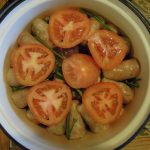
Below you can see particularly beautiful images from Făgetu, as well as the recipe in images of the famous zakrucana kapusta so zemiakmi, spun cabbage with potatoes.
Melt the smoked bacon and then fry the onion and pepper in the fat. Chop everything together with the meat. Potatoes are cut "grain of rice". Mix everything and add salt, pepper, herbs, thyme. Spin the dumplings and place them in the cauldron, add sprigs of dill and thyme, chopped tomatoes and broth and cover with cabbage leaves. They are ironed and smoked. Good appetite!




 English
  Romanian